Twenty-One Negatives
A buff-cloth Kodak Negative Album turned up among the family's photographs, with an interesting cast of characters but no names attached. There are a hundred negatives in its sleeves, and they were taken, it seems, over a year or so. We scanned twenty-one for inclusion in Moore Archives. Below is what we can say about the people based on what their photos show, together with a completely fictional account of how their year could have gone.
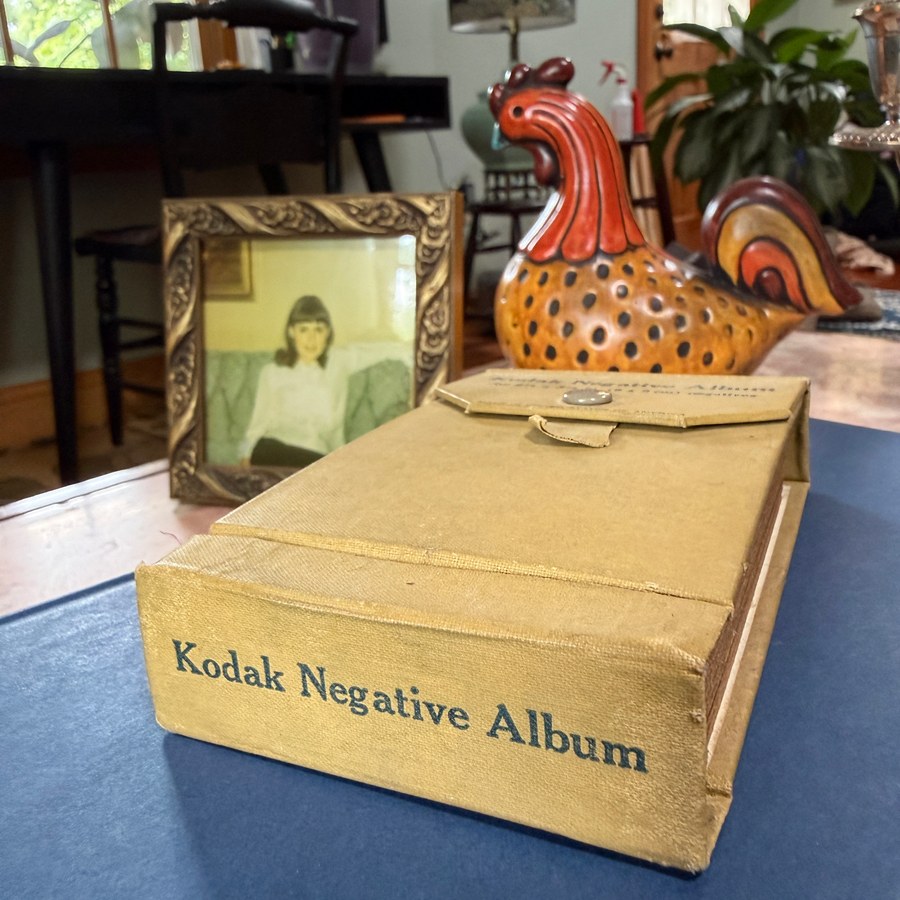
Five people, one camera
The evidence supports five distinct people: a woman, the two men she is photographed kissing, a blonde who is with her across the entire album, and a man at a field gun who appears once, in a season no other frame shares.
The album, and very likely the camera, is the dark-haired woman's: it outlasts both men and every location, and the blonde beside her through all of it is the one most often holding it.
What can be read off the film
Every frame was looked at under magnification. The film establishes a spring trip to the 1939 New York World's Fair, of at least two days by the outfits, with tulips in flower and the Queen Mary sailing from Pier 90, which puts it in May; a summer on Lake Erie, where a four-funnel steamer that can only be the Seeandbee puts the pier at Cleveland or Buffalo, with a day at a WPA wall and an evening at a farm fence; an autumn afternoon with a 1937 or 1938 Buick, dry grass and a brand-new house; and one frame, with bare trees, that belongs to none of them. The frames are grouped by the season they appear to belong to, not by their number.
A mark of certain means the thing is in the picture. Likely means the reading rests on a comparison or a well-known landmark. Guess is exactly that.
New York, spring 1939
Seven frames · the World's Fair opened 30 April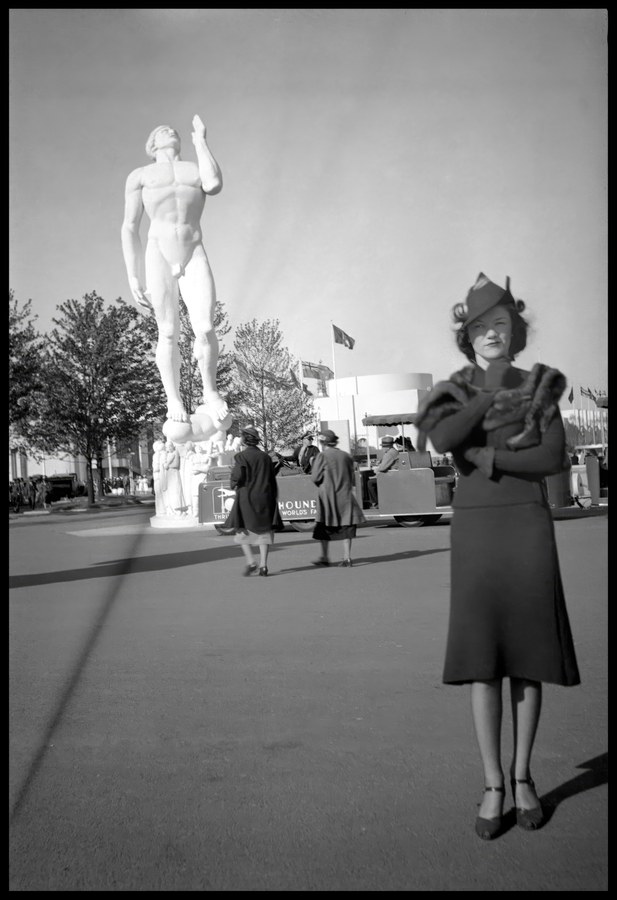
Freedom of Speech, and the Greyhound train
certainEvidence The dark-haired woman, fur piece over her shoulders, in front of a colossal nude male figure with his head thrown back and a hand cupped beside his mouth, standing on a sphere on a round drum ringed with smaller robed figures. Behind her a tractor train with an awning, lettered …HOUND and WORLD'S FA…. Trees in young leaf; long shadows.
Interpretation One of the Greyhound tractor trains that carried visitors around the 1939 New York World's Fair, which is what places the trip at Flushing Meadows. The figure is Leo Friedlander's Freedom of Speech, one of his four colossal plaster figures on Constitution Mall, the fair's main promenade: a period postcard of it shows the same shout at the sky, the same sphere under the feet and the same ring of listeners round the base, figure for figure. It was taken for Carl Milles's The Astronomer at first, which stood on a plain pier by the Lagoon of Nations and held its hands quite differently. The mall's roadway, flags and trees are all in the frame.
The Belgian Pavilion
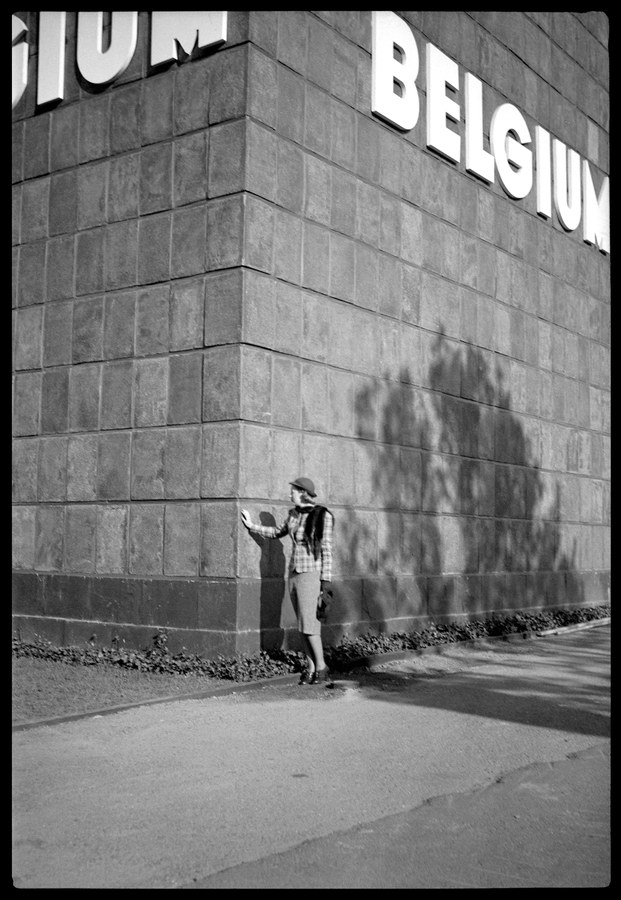
certainEvidence A woman in a plaid jacket and small round hat, a fur scarf, one hand flat against the corner of a wall of large square slate-grey tiles lettered BELGIUM on both faces. Tree shadows on the wall; a paved walk.
Interpretation The pavilion designed under Henry van de Velde, faced in Belgian slate. Its tower survives as the Belgian Friendship Building in Richmond, Virginia. Enlarged, the face and the lighter hair settle it: this is almost certainly the blonde, in a bigger check than the houndstooth the dark-haired woman wears elsewhere.
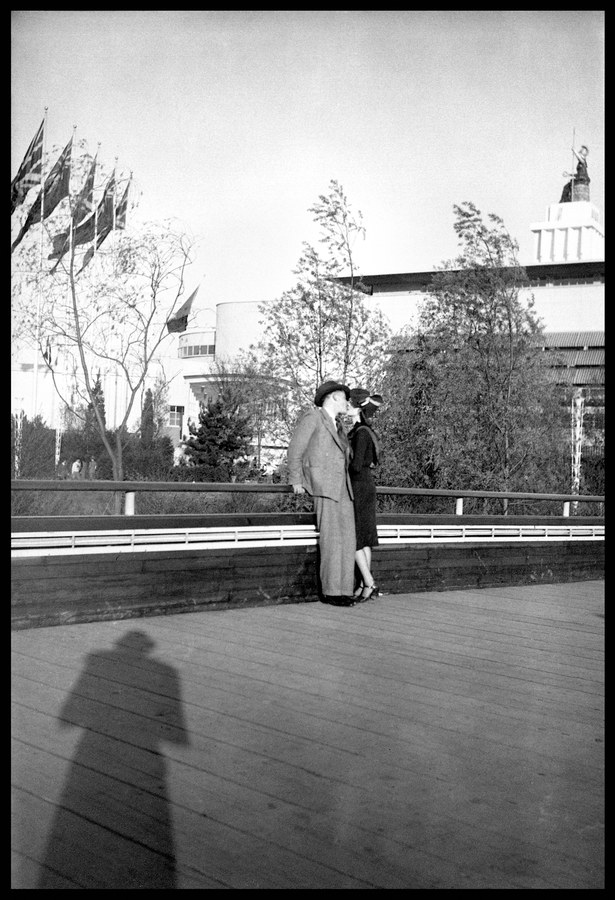
The kiss at the rail, and the photographer's shadow
certainEvidence A young man in a fedora and a light double-breasted suit kissing the dark-haired woman at a boardwalk rail. A row of national flags at left; at right, a white stepped tower crowned by a figure holding a staff aloft. Across the foreground boards lies the long shadow of the person holding the camera: a hat and a coat.
Interpretation The tower is the Italian pavilion's: a stepped white pylon with the seated figure of Roma on top, spear in hand, and a waterfall that fell the whole height of its face into a pool. Seen from the side here, so the water does not show. The shadow is the shape of a woman wearing a hat: almost certainly the blonde, who is with the dark-haired woman in several other frames of the album.
The bandshell and the tulips
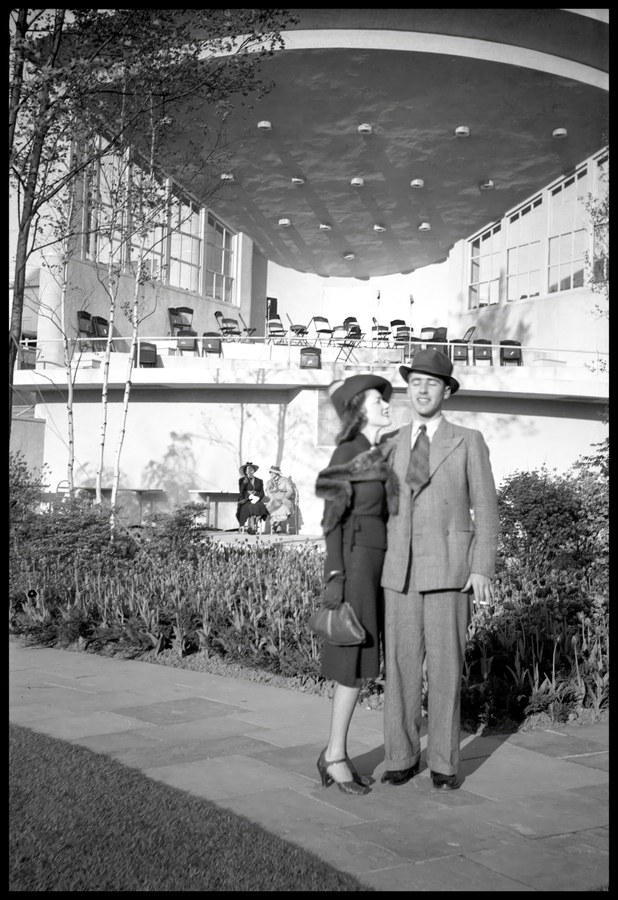
likelyEvidence The same young man, eyes shut against the sun and grinning, with the dark-haired woman looking up at him. Behind them an outdoor stage under a cantilevered oval roof set with downlights, folding chairs and microphone stands, birch trees, and a bed of tulips in flower. Two older women sit on a bench.
Interpretation Tulips in bloom put this in May. The architecture is the fair's streamline idiom. Which bandstand is not settled; the fair had several and the archives at the New York Public Library hold the drawings.
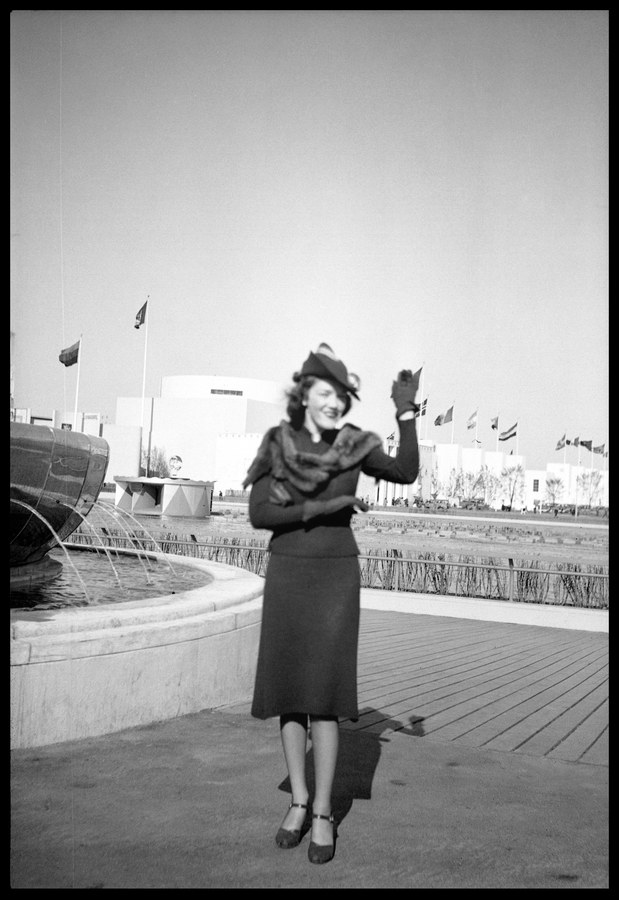
Waving by the fountain
likelyEvidence The dark-haired woman in a dark two-piece with a fur collar and gauntlet gloves, waving. A curved fountain bowl at left throwing jets into a basin, a boardwalk, a small pavilion with a striped conical roof, a great white cylinder with a round medallion, and a boulevard of flags.
Interpretation Somewhere on the fair's international side, near the Lagoon of Nations. Same hat and fur as the frame with the tall figure, so the same day.
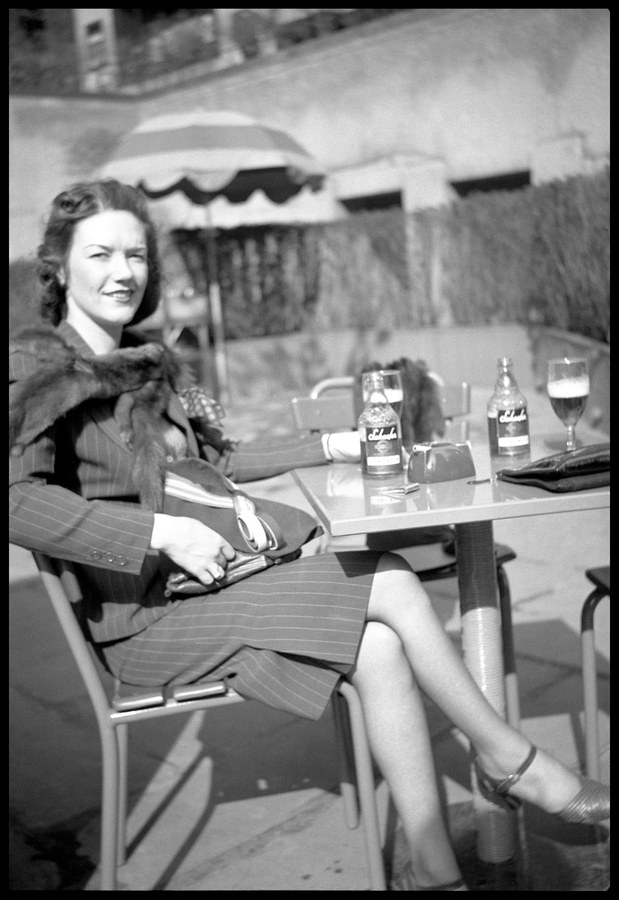
Two bottles of Schaefer
certainEvidence The dark-haired woman in a pinstripe suit and fur, legs crossed, at a chrome-legged table under a striped scalloped umbrella. Two bottles with a script label reading Schaefer, a stemmed glass of beer, a purse, a coin purse and a book of matches. A second glass at the far side of the table: somebody else is sitting there.
Interpretation F. & M. Schaefer, the Brooklyn brewer, ran the Schaefer Center at the fair, with an open-air bar and a restaurant seating sixteen hundred at ten cents a glass. Tubular steel chairs and a striped umbrella are exactly its furniture.
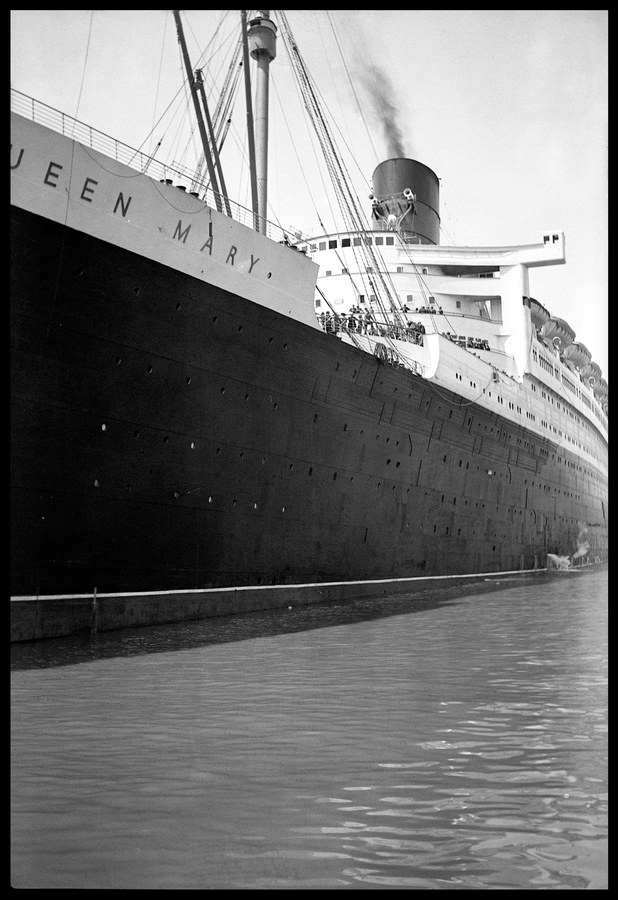
Queen Mary at Pier 90
certainEvidence The bow and name of RMS Queen Mary from the pier, hull in Cunard black, passengers crowding the forward rail, smoke from the first funnel. Taken from water level, looking up.
Interpretation She was in ordinary service until she reached New York on 5 September 1939, and left in grey war paint in March 1940. A black hull with steam up and people at the rail is a sailing day in 1939. Cunard's Pier 90 is at West 50th Street; the fair was a subway ride away.
The lake, summer 1939
Nine frames · the sharpest and the softest in the album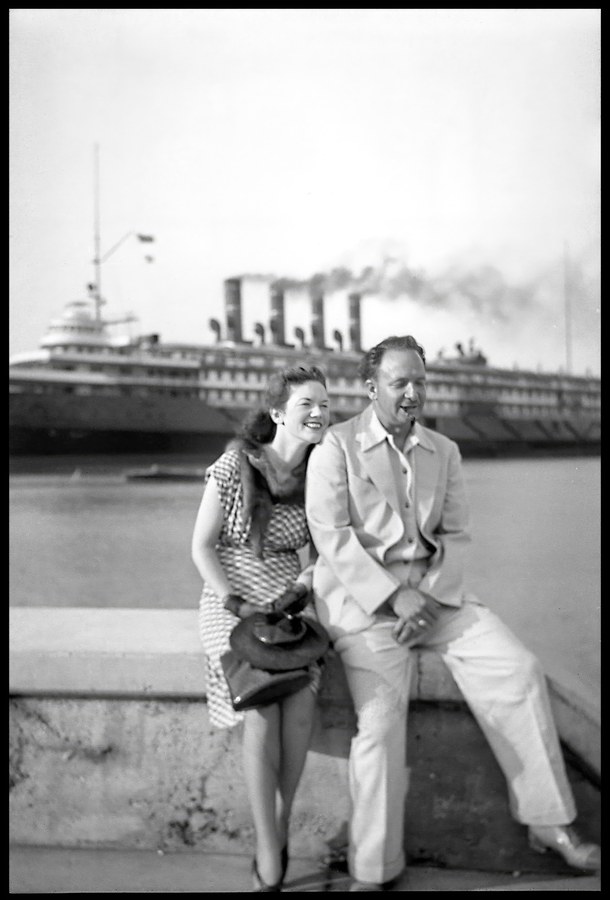
Four funnels
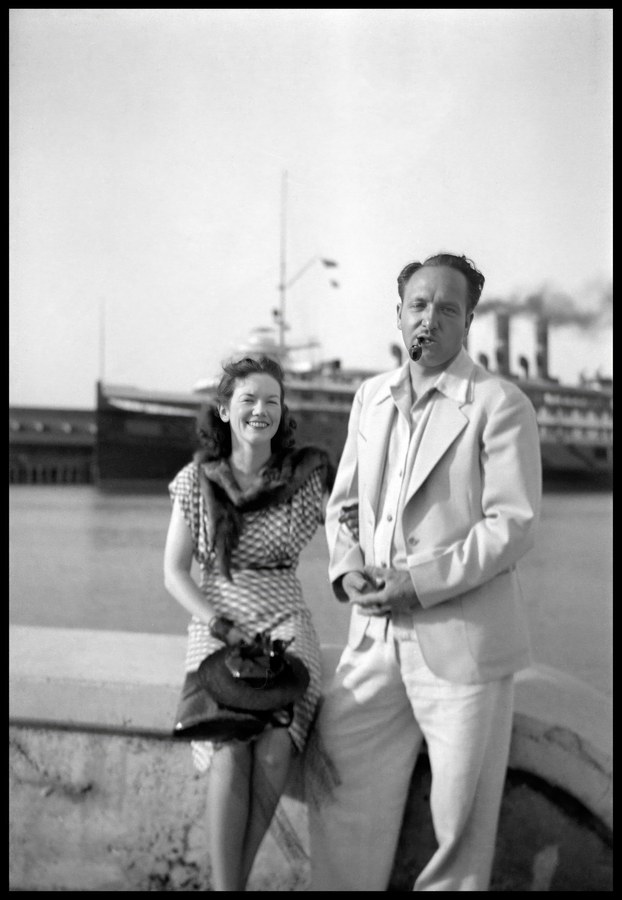
likelyEvidence The dark-haired woman in a checked dress with a fur piece, laughing, beside a man in a cream suit with an open collar and a pipe, seated on a stone seawall. Behind them a very long steamer with four tall funnels in a row, tiers of deck windows, a forward wheelhouse, smoke from all four stacks.
Interpretation Only one passenger ship on the Great Lakes ever carried four funnels: the Seeandbee of the Cleveland & Buffalo Transit Company, 500 feet, 1,500 passengers, nightly Cleveland to Buffalo from the East 9th Street pier, with summer cruises to Detroit and Chicago. In 1939 the company was being liquidated and she was sold to a Chicago concern. That she is under steam behind a promenade wall suggests a departure hour at Cleveland or Buffalo.
The same wall, standing
certainEvidence The pair again, standing. The man's thin moustache and receding temples are plain here; the pipe is clenched. The woman holds her hat and a dark bag. A pier lamp standard and the steamer's mast over the man's shoulder.
Interpretation Two frames of the same pose from the same spot: somebody was bracketing, or being asked to. Whoever pressed the shutter was a third person, and on this album's evidence the third person is usually the blonde.
The shoe
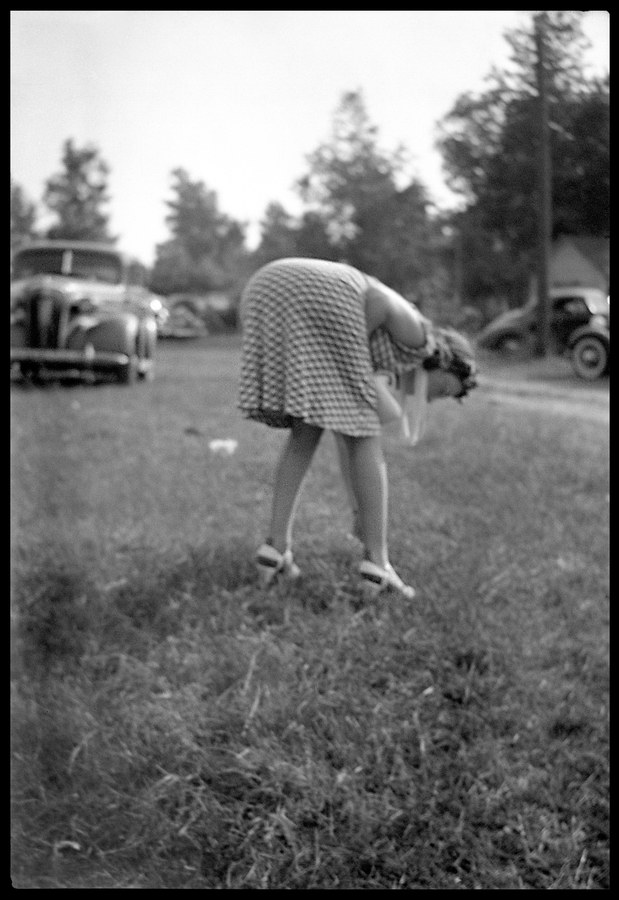
likelyEvidence A woman bent double, fixing a strap on her sandal, in the same checked dress as the seawall frames. Cars parked on grass, one a late-1930s sedan with a split grille, a tent-roofed building, pines. Focus missed entirely.
Interpretation The dress ties this to the ship day. A grassy parking ground with pines is a park or picnic grove, not a city pier. A candid, taken from behind, by someone who found it funny.
Shirt off, watch chain on
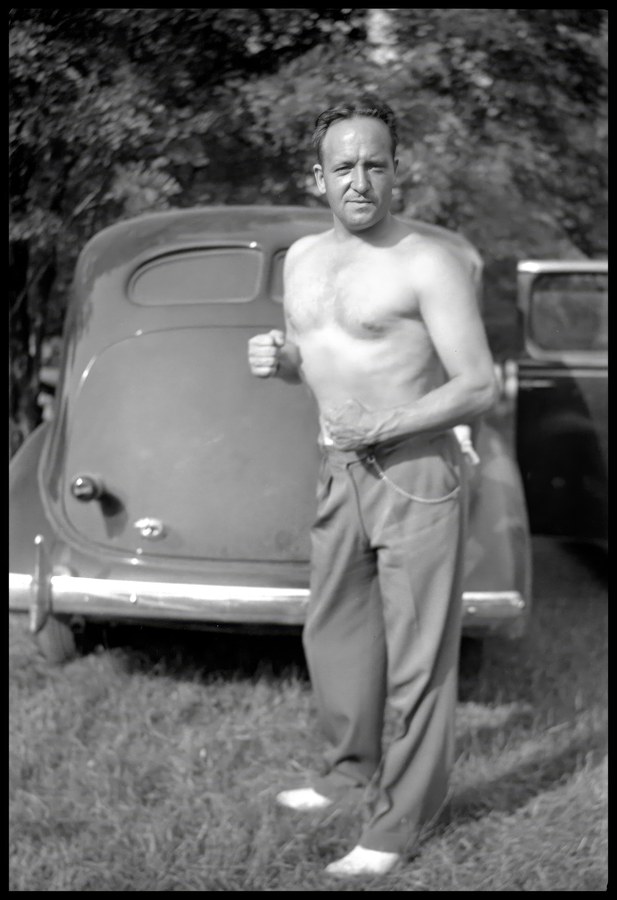
likelyEvidence A man stripped to the waist, a fob chain hanging from his trouser pocket, squinting at the camera in front of the rounded tail of a sedan with a two-piece rear window. Another car alongside. Deep shade under trees.
Interpretation Compared face to face with the man on the seawall, this is him: same widow's peak, same deep temples, and the faint line of the same moustache. The chain says he came in a suit and took it off.
Second take
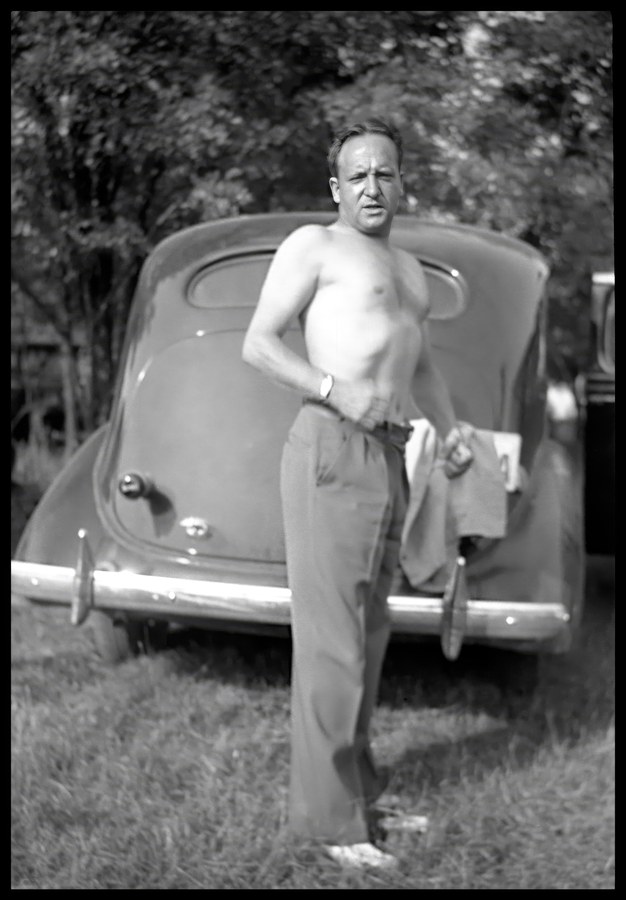
certainEvidence The same man, same car, now holding his shirt and a cap, a wristwatch on his left wrist.
Interpretation Two frames of him half-undressed and squinting. He is being photographed by somebody who is enjoying it.
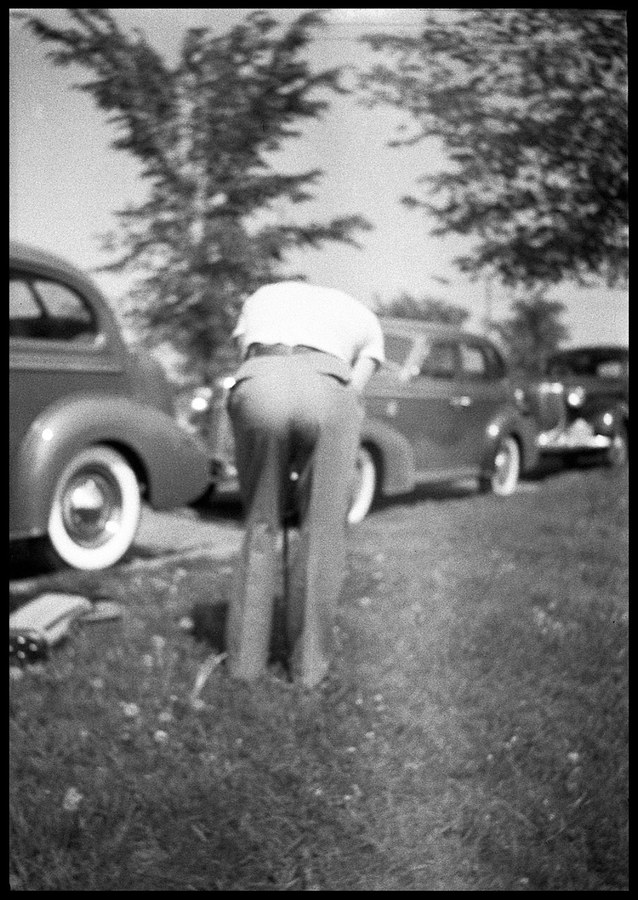
Bending, from behind
guessEvidence A slim man in a white shirt and light trousers, bent double with his back to the camera, on grass between parked cars with whitewalls. Out of focus.
Interpretation The answer to the shoe frame: the same joke played back. The build suggests the man with the pipe.
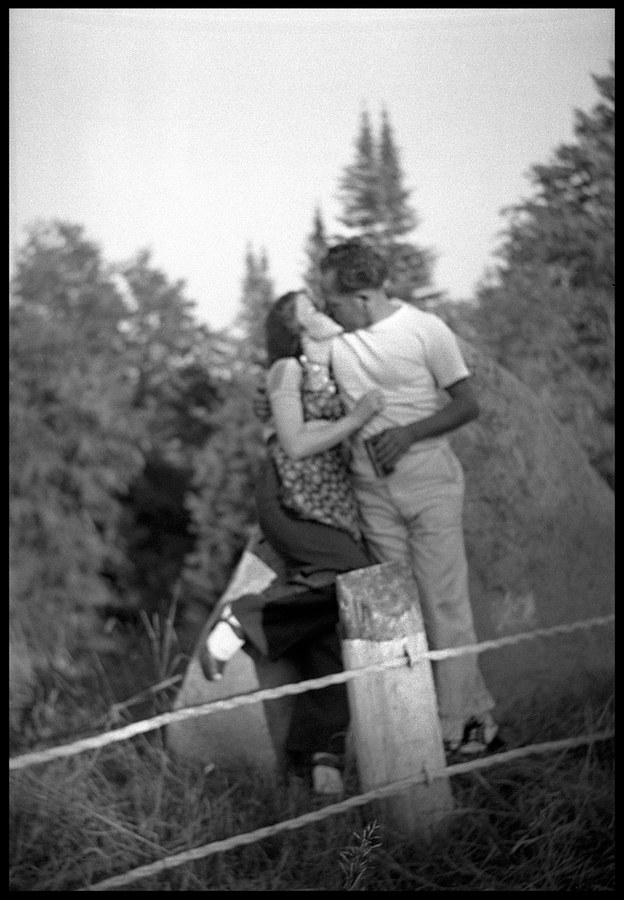
The fence post
guessEvidence A man in a white T-shirt and pale trousers kissing a dark-haired woman in a print dress who sits on a post, three strands of barbed wire between them and the camera, spruce trees behind. Soft focus.
Interpretation Clearly the man with the pipe. Evergreens and barbed wire are farm country north of the city, and the light is evening.
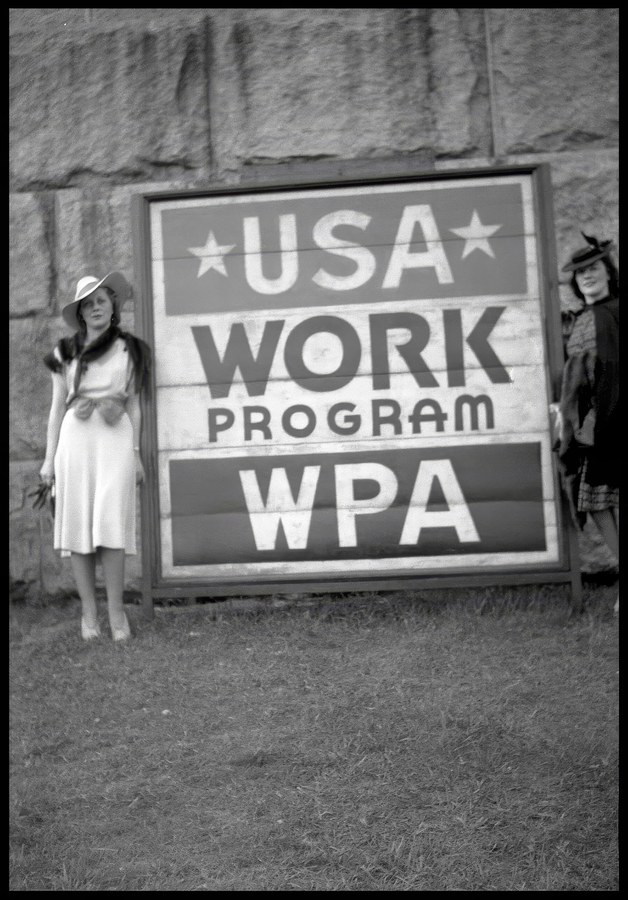
USA Work Program WPA
certainEvidence A blonde in a white dress, wide-brimmed hat and fur piece to the left of a painted board reading USA WORK PROGRAM WPA; to the right, mostly out of frame, a dark-haired woman in a dark jacket, plaid skirt and a hat with a veil. A wall of enormous dressed stone blocks behind.
Interpretation The Works Progress Administration put that sign on every project it built between 1935 and 1943. The blocks are a retaining wall or a park structure the WPA was still building. The two women posed on purpose, which says something about how they felt about the New Deal, or about the sign.
The two of them
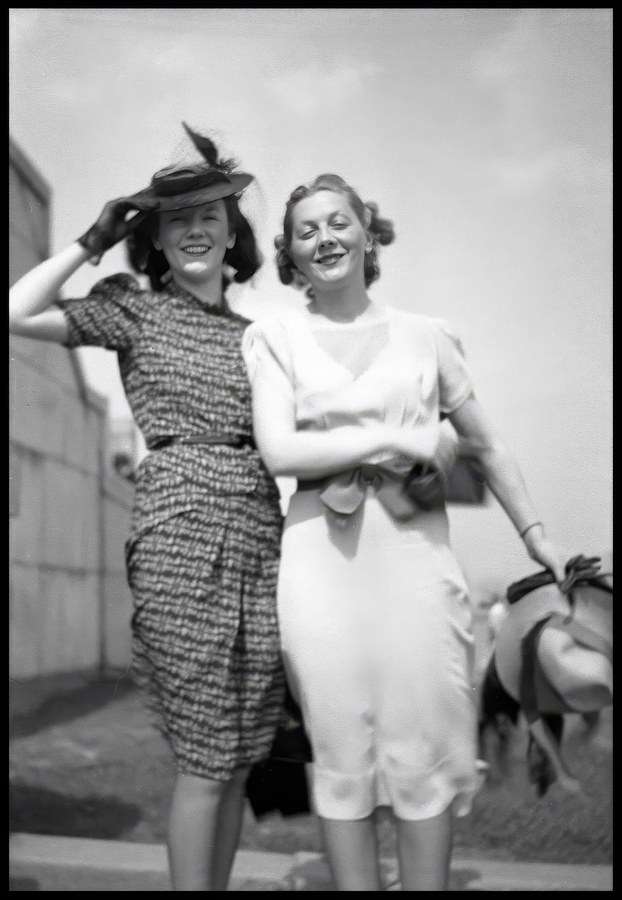
certainEvidence The dark-haired woman holding her veiled hat against the wind in a print dress; the blonde, in the same white dress and bow as the WPA frame, hat in hand, eyes narrowed. The same cut-stone wall at the edge. Both laughing.
Interpretation Same day and place as the WPA sign. The blonde appears to be the same woman who appears in several other photos from the collection, including the corner of Belgium.
Home ground, autumn 1939
Four frames · one outfit, one car, one afternoon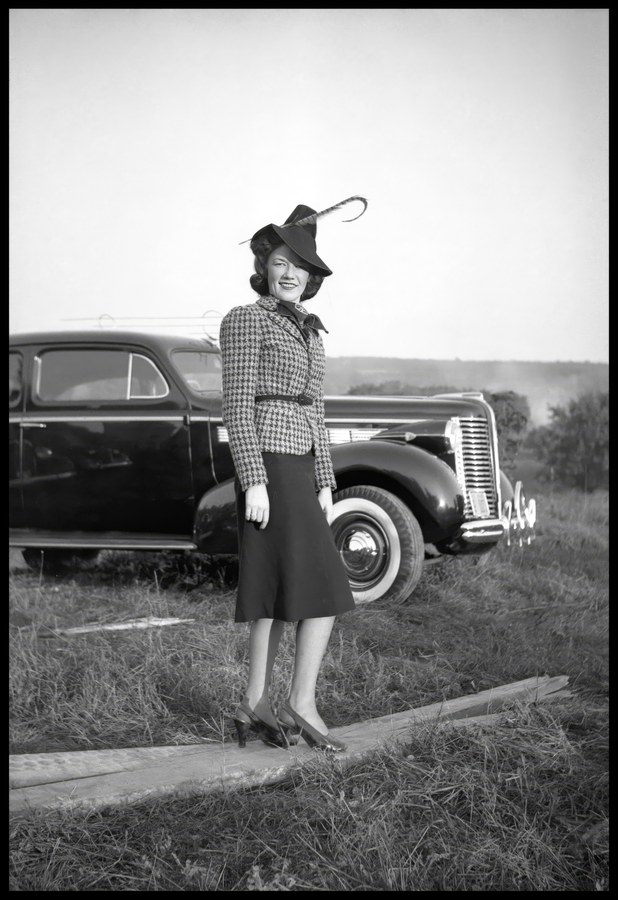
The Buick in the field
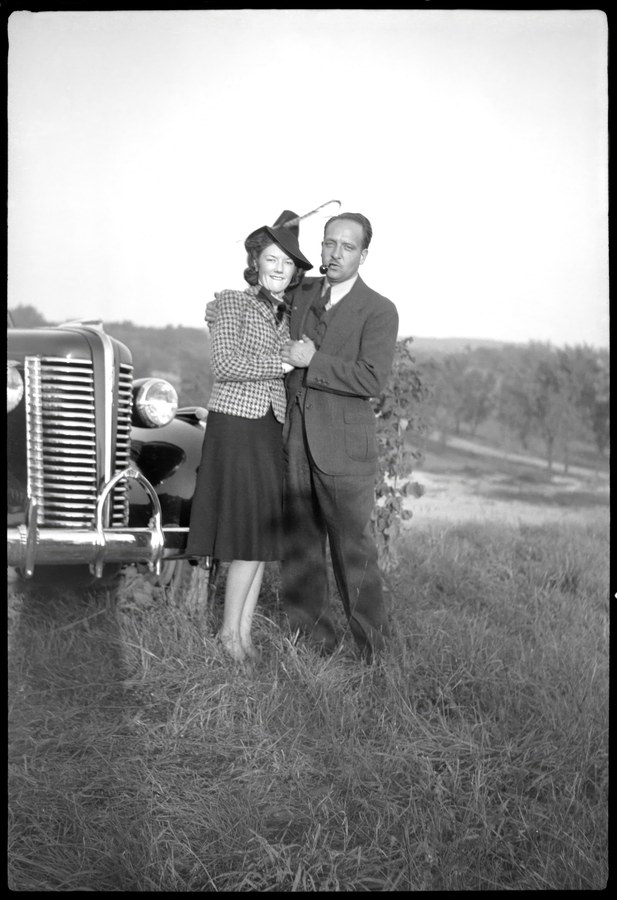
certainEvidence The dark-haired woman in a belted houndstooth jacket, dark skirt, and a felt hat with a long pheasant feather, balanced on a plank laid over dry grass. Behind her a black sedan with pod headlamps, a divided grille of stacked horizontal bars, whitewalls, and a plate on the grille. Hazy hills and a treeline. The sharpest frame in the album.
Interpretation The grille and lamps are a 1937 or 1938 Buick. Brown grass and a wool suit are October. The plank is there because the ground was wet, which is why she is smiling at whoever put it down.
At the grille
certainEvidence The same woman, same suit and feather, held close by the man with the pipe, in a dark suit and tie now. The Buick's grille fills the left of the frame. Orchard rows on the far slope.
Interpretation Same afternoon as the plank. Her cheek is against his and her hand is in his; this is not a family pose. The man with the pipe and the young man in the fedora are two different people, and across one year she is photographed kissing both.
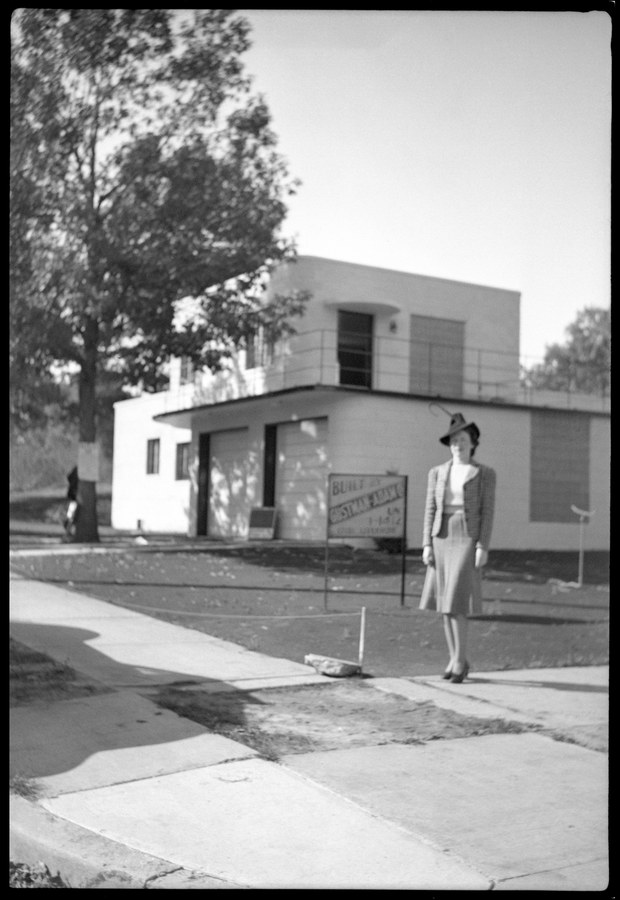
The house with the sign
likelyEvidence The same woman, same suit and feather, on a suburban sidewalk in front of a brand-new flat-roofed house in the streamline style: white stucco, a roof deck with pipe railings, an integral two-car garage, a raw lot roped off with string. A builder's board reads BUILT BY, a name set on the diagonal, a telephone number, and an address line. A tree in full leaf.
Interpretation The board is blurred past reading even at full magnification; the original negative under a loupe might give the builder's name, and with it the town. Whoever she is, she has been driven out to look at a new house, and dressed for it.
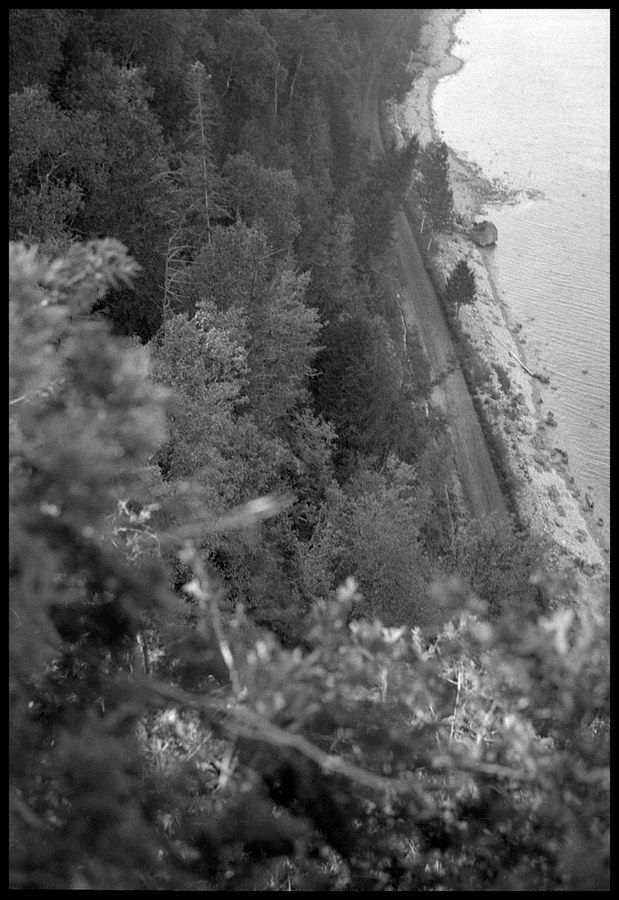
The road under the bluff
guessEvidence Looking almost straight down through spruce and hardwoods to a road at the foot of a bluff, a strip of stony beach, and grey water to the horizon. No people.
Interpretation Big water with no far shore: one of the Lakes. The conifers and the bluff suggest the northern shores, Lake Huron or Superior, more than Erie. The one landscape in the album, taken by someone who climbed to get it.
The odd one
One frame · a different season, a different manThe field gun
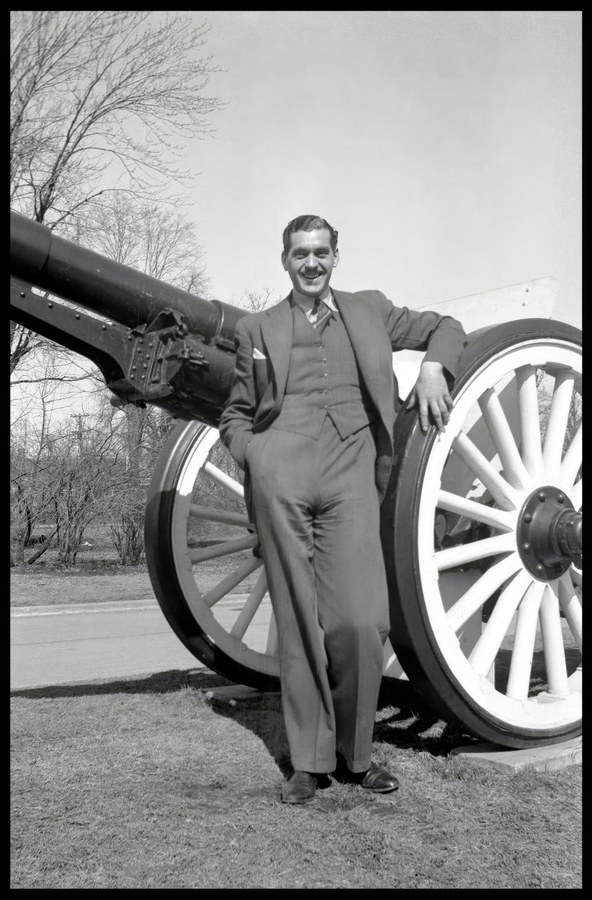
guessEvidence A man in a three-piece suit with a pocket square, hand in pocket, grinning broadly, leaning on the white-spoked wheel of a First World War artillery piece mounted as a memorial beside a road. Trees bare; a utility pole; brown grass.
Interpretation Compared at full size with the pipe-smoker, this is a different man: a longer and leaner face, a fuller moustache, heavier brows, and hair that has not receded at the temples. A fifth person, in the only frame without leaves on the trees. Bare branches and a suit with no overcoat mean March or April, or November. Every American town park had a gun like this after 1919.
Five names for five faces
What follows from here is invention. The names, the jobs and the family are made up to fit what the frames show, and nothing else.
These are fictional identities for people whose real names nobody living remembers. If a reader ever recognises a face, everything below should give way to what they know.
Irene Dvorak
Born 1915 above her father's bakery on Fleet Avenue, the younger of two children of Bohemian parents. Left Central High at sixteen when the bakery failed, and found the job that suits her: selling suits to women who cannot quite carry them off. The clothes in the album are the store's, bought at staff discount. The houndstooth with the pheasant feather is the autumn line of 1939.
The camera is a folding Kodak she bought herself with her Christmas bonus, and it is the one thing in the album that outlasts everybody else in it: two men, three seasons, a boardwalk in Queens and a wet field east of the city. She is in front of it in fourteen of the twenty-one frames, looking straight into the lens in most of them, and when she is not in front of it she is usually the one holding it. It is her album, and everything in it, the man she kissed at the rail and the one she kissed at the fence included, is a photograph she chose to keep.
Frank Bauer
Born 1905 on the west side to German parents, apprenticed to the engraving room at the paper at seventeen, which is where he learned about light: when Irene hands him her camera, his are the sharp frames. Met her in June 1939 when he came into Halle's to buy a black suit for his mother's funeral and she sold him a better one than he asked for. Bought the black 1938 Buick Special second-hand from a doctor in Shaker Heights the same month, out of a savings account he had been quiet about, and it is the reason the album ever leaves the city.
A bachelor with a pipe, a cream summer suit he is proud of, and a fob watch that was his father's. He is the man who knows what a house costs. He takes his shirt off when she asks him to and stands there squinting, twice, and kisses her across a barbed-wire fence with somebody else holding the camera, and none of it bothers him: of the two men, he is the one who is still there in October.
Eddie Marek
From Buffalo's Polish East Side; came to the C&B at nineteen counting tickets, and in three seasons worked up to the purser's office on the biggest boat on the Lakes. Met Irene in August 1938 when she and Rainey took the overnight run to Buffalo and back for the fun of it, and he undercharged them for the stateroom. Wrote to her all winter on company stationery.
His suit is the only one he owns, double-breasted, bought for the fair. He is in two frames, both at Flushing Meadows, and in both he is either laughing or has just stopped. He has the spring; the older man has the summer and the autumn. When the boat lay at the Cleveland pier in July with steam up, he was aboard her, and the woman on the seawall in front of her was sitting beside somebody else. When the company was liquidated in September and the boat was sold to Chicago, he went with the boat.
Lorraine "Rainey" Sutter
From Lakewood, a Lutheran pastor's daughter with a voice trained to be understood at any distance, which is what the telephone company pays her for. She went to New York as the chaperone Irene's father was promised, and was the one who knew Eddie would be at the gate on the second morning. She likes Frank and bet on Eddie, and said so to both.
She is in front of the camera in three frames and behind it for most of the rest: her shadow, hat and coat, lies across the boards in the kiss at the rail, and it was her thumb that missed the focus at the fence, because she was laughing. Wears white because she knows it photographs well. That she poses beside the WPA board in a summer dress, grinning, is her joke: her father called the New Deal godless and she calls it the reason her brother has a job.
Walter Gorski
He is in one frame, taken in a season no other frame shares, and Irene took it: nobody else in the album grins at her like that. Whether he comes before the whole year or after it is the album's last open question. Written here as after, because the trees are bare in November too, and because a man photographed at a war memorial in a three-piece suit with his hand in his pocket is a man on his best behaviour, being introduced. The suit is not a Sunday suit worn once a week; he wears one to the drawing office every day, and it fits him like it.
One year, in twenty-one frames
One way to arrange the twenty-one frames. Each chapter uses only what is in the pictures beside it, plus the invented lives above.
The shadow on the boards
They went by Greyhound, the two of them, sixteen hours through Pennsylvania on the overnight coach with the store's guidebook and a hatbox each, Rainey as the chaperone Irene's father had been promised and Irene with the camera in her lap. Eddie was at the Corona Gate on the second morning, off the train from Buffalo in the only suit he owned, by arrangement with Irene and a secret from nobody but her father. The boat did not fit out until the end of the month and he had three days.
Rainey took the pictures. She photographed Irene waving beside the fountain with the flags of every country behind her, and standing under Friedlander's white colossus Freedom of Speech, shouting at the sky on Constitution Mall, while a Greyhound tractor train rolled past, which was Rainey's joke about how they had got there, and sitting at the Schaefer Center with two ten-cent beers on the table and her legs crossed like a magazine, and the second glass at the far edge of the table is Eddie's. Irene took the one of Rainey at the corner of the Belgian pavilion, with her hand flat on the slate as though she were holding the building up. On the third afternoon they walked the boardwalk past the Italian pavilion, Roma with her spear on top of its tower of falling water, and Eddie stopped Irene at the rail and kissed her, and Rainey raised the camera because that was what she was there for. Her shadow lies across the boards in the picture, hat and coat, standing closer than she thought.
The morning they left, Eddie took them down to the river. The Queen Mary was sailing at noon from Pier 90 and he wanted to stand under something bigger than his own boat. Irene took the picture from the edge of the pier looking up, the whole black wall of her, the people at the rail waving at nobody. Eddie said the Seeandbee had four funnels and this one only had three. Then he kissed her again, with no camera on him, and took the train to Buffalo, and the two women got back on the coach.
Four funnels
Frank came into Halle's in June for a black suit and left with a better one and her telephone number, and by July he had the Buick. On the evenings the Seeandbee lay at the pier with steam up for the Buffalo run, he would drive the two women down to the seawall, Irene in the checked dress with the fox, which was too warm for July, and him in the cream suit with the pipe. Rainey took two frames of them from the wall with the four stacks smoking behind, one sitting and one standing: Frank with his pipe clenched and Irene laughing at something Rainey said from behind the camera. Somewhere on the boat behind them Eddie was counting tickets. Irene knew exactly what she was doing, and Rainey, who had bet on Eddie, took the pictures anyway, because it was Irene's camera.
The Sundays were Frank's and the Buick's. The WPA was building a wall of stone blocks the size of iceboxes in the park above the lake, with the sign up, red white and blue, and Rainey wanted to go see it, so Frank drove, and then the two women together, laughing, with the wind taking Irene's hat. That is the only picture of the two of them in the album and some would say the best one in it. At a farm north of the city, at the end of a long day, Frank in his undershirt kissed Irene on a fence post with the rope between them and the lens, and Rainey took it, out of focus, because she was laughing.
At a picnic grove with pines, Irene made him take his shirt off in front of the car and stand there squinting while she took two of him, and he let her, with his watch chain on. He took one of her from behind, fixing her sandal strap, and she got the camera back and took one of him bending over, and everybody laughed, and that was the summer.
The plank
In September the war started, and the same week the C&B announced it was done. The company that had run boats out of Cleveland since 1892 was in liquidation and the Seeandbee was sold to a Chicago outfit that would run her on the upper lakes. Eddie could go with the boat or stay with the town. He went to Chicago for the last cruises of the season to think about it, and his letters got shorter.
Frank, who was not a man to leave a question alone, spent his Sundays that autumn driving Irene out to look at houses. Some builder was putting up flat-roofed white boxes with roof decks on a raw street, the kind of thing the fair had promised, and the board out front said BUILT BY and a name and a telephone number. Irene handed him the camera and stood on the sidewalk in front of it in the new houndstooth suit with the pheasant feather, very straight, and neither of them said what the picture was for.
Afterward he drove out past the orchards to a field where the ground was wet, and laid a plank across the mud so she would not spoil her shoes, and she stood on it and laughed at him for it, and he took the sharpest picture in the album; he had learned about light in the engraving room. Then Rainey, who had come along in the back seat because she always did, took the camera, and Frank put his arm around Irene with his pipe in his teeth, and she put her cheek against his and her hand in his. It is the last frame Rainey took of the two of them, and the first in which she did not mind.
The gun in the park
Eddie wrote from Chicago the week before Armistice Day to say he was staying with the boat. The letter came to the house on Prospect Avenue, and Irene read it at the kitchen table while Rainey, who had stayed for supper, pretended to do the dishes. She folded it and put it in the back sleeve of the album, where it is not any more. Frank was not there. He heard on the Sunday, when he came for her in the Buick. Rainey, who had bet on Eddie and lost, held that this was Frank's moment: the other man was gone, he had spent the autumn driving her past builders' houses, and all he had to do was ask. He did not ask. He put his hat on and took her for a drive as if nothing had changed, which Rainey said afterwards was the only mistake he made all year.
The last frame in the album is of neither of them. It is a man in a three-piece suit with a pocket square and his hand in his pocket, leaning on the white wheel of the old field gun by the war memorial, and grinning at the camera so widely that he can only be grinning at whoever is holding it. The trees are bare. Irene took it. He was a draftsman from Ford's engineering building at Dearborn, a Detroit man in town for a cousin's wedding, and she met him in the ladies' ready-to-wear on a Saturday in November, buying a suit for his mother that she talked him out of.
The one frame nobody is in, the road under the bluff with the big water going out to nothing, she took by herself. It was September, the week the boat was sold, and Frank had driven her out along the shore on a Sunday and stopped where the bluff comes down to the lake. He stayed in the car with his pipe. She took the camera and climbed the path through the trees to the top, and photographed the road she had just left and the water beyond it. It is the only picture in the album she planned before she took. The album was hers, and she kept everything in it, Frank's bare chest and the kiss at the rail included, because a picture you have to take out is a picture you should not have taken at all.
How the album came to be stored with a Detroit family's photographs is not in the pictures. Boats go from Cleveland to Detroit, and so do draftsmen, and so does a woman with a camera and an album she has stopped opening. That is as much as the film will tell on its own.
What would change the story
Frame 6 carries a name and a telephone number. They are blurred past reading in the 2704-pixel scan, but a loupe on the original negative, or a scan at 4000 pixels or better of that one square inch, might recover the name. A builder's name and exchange would give the town, which would settle where these people lived.
The older man has the summer and the autumn: the seawall, the fence, the house and the Buick. The younger has the spring at the fair. Whether that is a choice being made across a year or two affairs kept apart is the story's biggest bet. A wedding ring is visible on nobody with any certainty; the hands are too small at this scale.
The man at the field gun appears once, with bare trees, and matches neither of the others. If the frame is from March 1939 he comes before the whole year; if from November, after it. The album's order might settle this, and so would the seventy-nine sleeves that were not printed.
The four-funnel reading is confident but rests on funnel count and hull length. A print of frame 5 at full size might show her name on the paddle box, and would tell whether the pier is Cleveland, Buffalo, Detroit or Chicago.
Eight 6 × 9 frames to a roll of 620 or 120 film: a folding Kodak or a German equivalent, with a lens good enough for the Buick frame and a photographer who missed focus on close subjects more than once. It passed from hand to hand; the blonde held it for most of New York, and the album did not follow her. The story takes the album, and so the camera, to be the dark-haired woman's, because she is the one constant across two men and three seasons, and that is a reading rather than a fact.
The album holds a hundred sleeves. Twenty-one were chosen to print. Whatever is in the rest is the answer to most of the above.
What the certain and likely readings rest on
- Seeandbee, Encyclopedia of Cleveland History, and Cruising the Great Lakes aboard the Seeandbee
- Two of the Four Freedoms sculptures at Constitution Mall, Library of Congress, and Friedlander's Four Freedoms, Constitution Mall, Fresno State's World's Fair collection
- The Belgian Building, Richmond, and Architectural Record on the Belgian pavilion
- 1939 New York World's Fair, Wikipedia, for the Greyhound tractor trains and the Italian pavilion
- The Schaefer story, and Queens Chronicle on the Schaefer Center
- Queen Mary's war service, and the Queen Mary timeline